WHY DIGITAL DETOX ONLY TREATS THE SYMPTOMS
A masterclass on digital overload, manipulative fields, and the real solution
The quality of your reality begins with the quality of the information that surrounds you.

DIGITAL DETOX & ELECTROSMOG ARE ONLY THE TIP OF THE ICEBERG
You’ve reduced your screen time. Turned off notifications. Perhaps you’ve even installed a digital detox app to remind you to spend less time on apps. You may have treated yourself to a digital detox retreat or tried spending a Sunday without your smartphone.
And yet, perhaps you know this feeling: you close your laptop, put your phone aside, and still don’t quite feel present with yourself.
Your mind is full. Your attention jumps from one thought to the next. Something you saw in the news, in a video, or in a passing comment you happened to read stays with you for hours.
Why is that?
When we talk about digital overload, we usually talk about electrosmog, Wi-Fi, Bluetooth, mobile networks, 5G, and human behaviour. We talk about smartphone addiction, excessive screen time, a lack of self-control, and the need to use our phones less.
That’s not wrong. But it tells only part of the story.
While we debate how much time we should spend online, we rarely ask another question:
What is the quality of the digital environment in which we spend a significant part of our lives?
What if digital overload depended not only on how long you look at a screen, but also on what you connect with while you’re using it?
This is where a perspective begins that goes beyond conventional digital detox concepts. It may change not only the way we use technology, but also our understanding of what it means to live a harmonious life.

DIGITAL DETOX: WHY LESS SCREEN TIME ISN’T THE WHOLE STORY
The usual recommendations for dealing with digital fatigue are easy to summarise: reduce screen time, turn off push notifications, limit social media, and practise mindful media consumption.
Digital minimalism and slow media follow a similar idea. They aim to help us use technology more intentionally instead of filling every available moment with digital stimulation.
All of this can be valuable.
If you’re constantly available, you need boundaries. If you read the news first thing in the morning and fall asleep with your smartphone at night, setting fixed offline hours may help. And if you habitually spend every spare minute scrolling, taking a digital break can create more room for your own life again.
But imagine two people.
The first spends three hours online watching peaceful nature footage, researching an interesting topic, and keeping in touch with friends.
The second spends the same amount of time in an endless stream of disaster reports, aggressive comments, artificially constructed ideals, and alarming videos.
Their screen time is identical. Their information environments are not.
That is why measuring digital overload solely in minutes is too simplistic.
A digital detox app can show you how long you use a device. It can remind you to take a break. But it cannot automatically tell you which content is capturing your attention, which patterns you repeatedly absorb, or what kind of atmosphere your digital habits create.
There is also evidence of associations between doomscrolling and psychological distress. This does not, however, mean that every form of intensive use inevitably causes negative effects, or that there is just one underlying cause.
The crucial next step is this:
It is not only how much digital information you take in that deserves attention. The kind of information you take in—and what it does to you—matters, too.

DOOMSCROLLING: WHEN YOUR ATTENTION BECOMES THE BUSINESS MODEL
You only wanted to check the news quickly.
Then you see a video about a crisis. Below it is a comment that makes you angry. You open the discussion, read more reactions, and click on the next post. Suddenly, you find yourself looking at a topic you never intended to search for.
An hour later, you know more about the world’s disasters and feel completely drained.
This behaviour is known as doomscrolling: the prolonged, often difficult-to-stop consumption of predominantly negative or threatening online content.
Why is it so hard to stop?
Threatening information can command our attention particularly strongly. At the same time, endless scrolling, automated recommendations, and a constant stream of new content make it tempting to keep going. The next video might finally explain what is happening. The next headline might finally provide some clarity.
But the feed has no natural ending.
Many digital platforms operate on business models in which attention and engagement have economic value. Recommendation systems can encourage us to stay longer, view more content, and keep coming back.
That doesn’t mean every algorithm is deliberately designed to create fear. It does mean, however, that the interests of a digital system do not automatically align with our personal needs.
You may be looking for clarity. The system is optimised for engagement.
You want to stay informed. You’re given more and more reasons to keep reading.
You want to connect. In the end, you find yourself comparing your life with those of people whose lives you know only through a carefully curated online presence.
This creates a peculiar dynamic: we invest our attention in systems designed to capture that attention as efficiently as possible.
And attention is precious.
It helps determine which thoughts we explore more deeply and which subjects we give space to in our everyday lives. What we look at regularly becomes more familiar. What we repeatedly engage with can shape our perception.
That is why doomscrolling is not simply a matter of self-discipline. It is also about the relationship between people, content, and the digital environment.

DIGITAL SPACES ARE MORE THAN THEIR VISIBLE SURFACE
When you enter an old greenhouse, you don’t just notice glass, metal, and plants. You experience the light, the temperature, the scents, and a particular atmosphere.
A library feels different from a railway station. A garden feels different from a busy airport.
We readily accept that our surroundings consist of more than the objects we can see.
We often forget this when it comes to digital spaces.
We see a display, an app, a website, or a video. Behind it, however, are complex technical and social structures: algorithms, design patterns, communication rules, collective expectations, and the emotions of the people who inhabit these spaces.
A news website is organised differently from a creative forum. A comment section full of aggression creates a different social dynamic from a community in which people support one another.
These differences are not mysterious. They can already be observed at the level of communication, psychology, and group dynamics.
But they raise a further question: could a digital space also be understood as an information field whose overall quality extends beyond the sum of its individual pieces of content?
In my work with Evogia™, I also approach digital technology from a metaphysical perspective. I look not only at what appears on a screen, but also at the information structures and resonance patterns that may lie behind it.
THE INVISIBLE DYNAMICS OF THE COLLECTIVE
The idea that the internet is merely a technical network of data packets and servers is too narrow.
Over time, every digital space develops its own dynamics.
Some seem to encourage kindness. Others thrive on outrage.
Still others generate constant comparison, acceleration, or the feeling that you are never enough.
Psychologists refer to group dynamics and social conditioning in this context.
The biologist Rupert Sheldrake coined the term morphic fields to describe subtle fields that can become stabilised through repetition and influence behaviour.
A related concept exists in spiritual and philosophical traditions: the egregore.
It refers to a collective field of thought and resonance that arises through the attention, emotions, and actions of many people and gradually consolidates into a dynamic of its own.
Regardless of which explanatory model one follows, both perspectives describe a remarkable observation:
The more often people think the same thoughts, nurture the same emotions, and repeat the same patterns of behaviour, the more stable the field they create together becomes.
Today, digital platforms connect billions of people simultaneously.
Never before in history has it been possible to create collective spaces of resonance on this scale.
And this is where a dimension begins that has, until now, been discussed surprisingly rarely.
If digital spaces really are more than neutral technical infrastructures—if they give rise to atmospheres, spaces of resonance, and collective information fields—then this changes the way we think about technology.
Not merely as a tool, but as an information field that shapes consciousness.
And perhaps this is precisely the starting point for a deeper understanding of why digital technologies can affect us so profoundly, even when we believe we are simply reading a news story or scrolling through a feed.

MANIPULATIVE COLLECTIVE FIELDS
Many people believe that when they switch on their smartphone, they are simply connecting to the internet.
In reality, they are connecting to much more.
Billions of thoughts.
Billions of emotions.
Billions of reactions.
The internet is not just a technical network. It is also a collective space of resonance.
Every news story, every comment, every video, and every search query becomes part of a vast information field that continually reinforces itself.
Fear reinforces fear. Outrage reinforces outrage. Envy reinforces envy.
The more often billions of people nurture the same emotions, the denser these collective spaces of resonance become. From the perspective of morphogenetic field models, we therefore encounter more than individual pieces of content in the digital world. We also encounter the overarching information fields fed by countless similar thoughts, feelings, and behavioural patterns.
In everyday offline life, we usually encounter the emotional states of only a relatively small number of people.
In the digital world, we can come into contact with the emotional resonance of billions of people within minutes.
A sensory overload on every level.

THE HUMAN BEING AS A RESONANCE BODY
So far, we have looked at digital spaces.
Now let’s turn our attention to the human being.
Because the crucial question is not only what information reaches us every day.
It is also this:
What, exactly, is the being that receives this information made of?
The human body consists largely of water.
Every cell communicates continuously with billions of other cells. Hormones transmit messages. Nerve cells send electrical signals. The immune system recognises patterns. Every second, the brain processes unimaginable amounts of information.
Life, therefore, is much more than biochemistry.
Life is communication. An ongoing exchange of information.

THE CRYSTALS OF OUR BEING
The Japanese author and water researcher Masaru Emoto brought worldwide attention to experiments in which frozen water crystals were photographed after being exposed to different influences. He claimed to demonstrate that words and music, for example, influence the formation of these crystal structures (Emoto, M., 2002, The Message from Water, Koha Publishing).
Decades later, New Zealand water researcher Veda Austin took up similar questions. She, too, photographs the patterns formed by freezing water and interprets them as expressions of information previously received (Austin, V., 2021, The Secret Intelligence of Water: Macroscopic Evidence of Water Responding to Human Consciousness, self-published).
If water is sensitive to information, and the human organism consists predominantly of water, what significance might the information we expose ourselves to every day have?
MANIPULATIVE SYMBOLIC STRUCTURES AND THE OCCULT DIMENSION OF DIGITAL TECHNOLOGY
Our brains process symbols in fractions of a second. Long before we read a text, our subconscious has already registered shapes, colours, and archetypal patterns.
That is precisely why companies invest billions in logos, icons, and interface design. A symbol is not merely meant to be recognised, it is meant to make us feel something.
Some motifs draw on archetypes that are thousands of years old: the fruit as a symbol of knowledge or temptation; the endless loop as a symbol of attachment or cycles; the all-seeing eye; labyrinths; hexagrams; black cubes; spirals; and geometric constructions with deeply rooted cultural significance.
There is another aspect, too: numerous interpretations circulate online suggesting that certain well-known logos or interface elements deliberately allude to esoteric, alchemical, or occult symbolism. Some, for example, are said to contain hidden numerical patterns, geometric codes, or references to historical secret societies.
None of this is accidental. These are deliberately chosen symbols that operate on subliminal, manipulative levels. This goes beyond mere marketing and design. It is a form of occult manipulation: occult means hidden. These symbols work on an unconscious level and influence our energetic system.

THE QUIET LOSS OF ENERGY: WHAT DIGITAL SPACES DO TO YOUR FIELD
There is a question hardly anyone asks.
What actually happens to my inner state while I am using a digital device?
We may pay attention to screen time, productivity, and notifications, but what about the quality of our own field? The effects of digital technology begin the moment we switch on a device.
As part of the Evogia™ Coherence Analysis, I examined precisely this level.
The same pattern emerges again and again: contact with a conventional digital device is accompanied by a significant decline in personal energy levels. The more destructive the content to which a person is exposed, the more pronounced this effect.
The more time we spend on digital devices, the greater the loss of life energy.

THE VALUE OF ATTENTION AND LIFE ENERGY
From an economic perspective, attention has long since become the most valuable currency of the digital age.
Platforms compete for it.
Algorithms are optimised to capture it.
The longer we allow ourselves to be drawn into this dynamic, the greater the risk of losing touch with our own inner sense of direction.
Step by step, the centre of our actions shifts from within to the outside. From a metaphysical perspective, however, this competition may extend even further.
If information is the fundamental structure of reality, as quantum physics is understood to suggest, another question arises:
Is attention and life energy valuable only in economic terms, or on other levels as well?

ENERGY HARVESTING, LOOSH, AND PARASITIC EXTERNAL ENERGIES
Who actually benefits when billions of people invest their attention every day in fear, outrage, envy, and constant sensory overload?
On a level that is readily understandable, digital business models benefit from attention, reach, and engagement. Content that encourages people to click, comment, or return can have economic value.
The term *loosh*, by contrast, comes from an esoteric and metaphysical framework. It is used to describe the energetic harvesting of human life energy or emotional states by parasitic entities.
In nature, there are organisms that live on light.
Others feed on organic matter.
From a metaphysical perspective, there are also parasitic entities that preferentially feed on low-frequency emotions such as fear, hatred, envy, and outrage. These entities do not generate life energy themselves, which is why they need a host.
Whether one understands these phenomena literally, symbolically, or as a model is a matter of personal interpretation.
What matters is the experience many people report:
After long periods of scrolling, they often feel not nourished, but exhausted.
Not clearer, but more scattered.
Not more connected, but inwardly empty.

BLACK MIRROR: WHEN TECHNOLOGY BECOMES A PORTAL
There is a term used in science fiction: Black Mirror.
A black mirror is a portal: a gateway to another dimension, another reality.
On the subtle level, so-called black-box technologies do indeed exist: devices whose field structure is so disorganised, chaotic, and fragmented that they become portals for low-frequency information.
These are destructive; they draw you into frequencies of fear, confusion, hopelessness, and dependency.
Digital devices can open such portals to low-frequency realities. And the more you scroll, the longer you remain there, the more these frequencies infiltrate your energy field.
That is why doomscrolling is so destructive. It is not merely psychologically addictive. It is destructive on the subtle level, because we unconsciously attune our own information field to precisely these frequencies.
Perhaps the most important question of our time is therefore not:
How much time do you spend online?
But:
What reality are you entering when your screen lights up?
Because every screen is more than matter.
It is an interface.
And every interface connects two worlds.
The only question is: which ones?

ARE TECHNICAL DEVICES REALLY INANIMATE?
Silicon. Copper. Glass. Plastic.
Electrons flow through circuit traces, software processes data, and that seems to tell the whole story.
But that is only the material level.
For thousands of years, various spiritual and philosophical traditions have described the world as fundamentally ensouled, as an expression of a universal intelligence underlying all existence.
According to this view, even human-made objects possess a subtle organisational structure, referred to by geomancer Dr Ralf Otterpohl as technological elemental beings (Otterpohl, R., 2026, Maximal Vital: Vital Energy for People, Homes and Their Surroundings, Gartenring org Verlag).
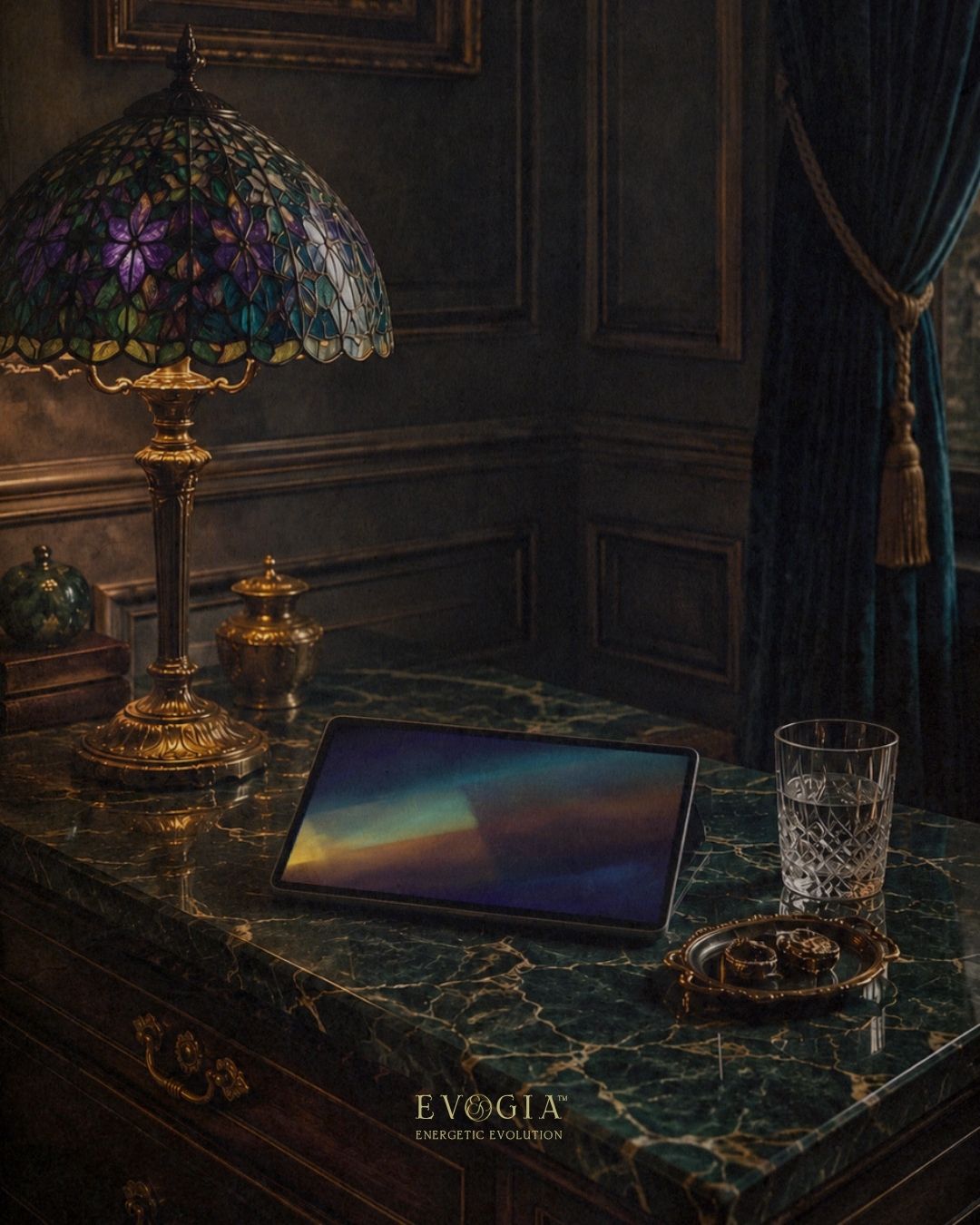
DOES TECHNOLOGY CARRY CONSCIOUSNESS?
From this metaphysical perspective, the manufacture of a technical device creates more than a physical object.
A subtle structure also takes shape and remains connected to the device.
It carries the imprint of its creation.
The conditions under which it was manufactured.
The intentions behind its development.
The quality of the information incorporated throughout its entire development process.
Dr Ralf Otterpohl maintains that these technological elemental beings are not free, but are bound to the function of the respective device.
From this perspective, they are not independent beings, but fragments of consciousness whose existence is entirely coupled to a technical system—a form of subtle-level enslavement. This view raises profound questions about the relationship between human beings, technology, and consciousness.
If a device was primarily developed to capture attention, influence behaviour, or reinforce dependencies, might that underlying orientation also become imprinted on its metaphysical level?

AN INVITATION TO THINK FURTHER
What if our relationship with the world were far more dialogical than we have assumed?
What if objects were not merely passive things, but carriers of an informational quality that enters into resonance with us?
And what if technology not only influenced our attention, but also carried its own subtle history within it?
Perhaps a more conscious relationship with technology begins right there.
Not merely with the question of which device we buy.
But with the question of how we relate to the things that accompany us every day.
Perhaps you have experienced something yourself that was difficult to explain.
A technical device suddenly stopped working. You became frustrated. Nothing helped.
Then you spoke kindly to the device—perhaps half-jokingly.
You thanked it. Or even apologised to it. And suddenly, it started working again.
Was it coincidence?
Or are we intuitively responding to something that our materialistic worldview has so far barely taken into account?
Interestingly, people from very different cultures repeatedly report similar experiences.
Not only with technical devices.
But also with plants. Animals. Houses. Musical instruments. Vehicles.
Perhaps our surroundings are more responsive than we have been taught to believe.

BASIC PRACTICES FOR DIGITAL FIELD HYGIENE
What does field hygiene mean in everyday digital life?
For me, it begins with a simple realisation: we consciously design our living spaces, choosing furniture, colours, lighting, and art, yet we often leave the design of our digital devices to their default settings.
And many of us spend a considerable part of our lives with these devices.
Digital field hygiene means paying more conscious attention to the quality of this environment. It combines practical habits with an additional metaphysical perspective on information and coherence.
This involves several levels.
1. MINDFUL MEDIA CONSUMPTION
Choose your news sources and content deliberately. Ask yourself whether another post genuinely provides new information or merely triggers the same emotional reaction once again.
2. RECLAIMING YOUR ATTENTION
Turn off unnecessary notifications, limit autoplay, and deliberately create screen-free periods. Taking a digital break can help you gain some distance and become more aware of your own needs again.
3. SHAPING YOUR INFORMATION ENVIRONMENT
Unfollow accounts that regularly draw you into destructive patterns of comparison. Seek out content that encourages knowledge, creativity, and genuine connection. You do not have to consume everything that technology makes available.
4. REFLECTING ON THE QUALITY OF YOUR DEVICE ENVIRONMENT
Consider not only the apps you use, but also your relationship with the devices themselves. What role do they play in your everyday life? Which habits have taken hold? What values do you want to guide your digital use?
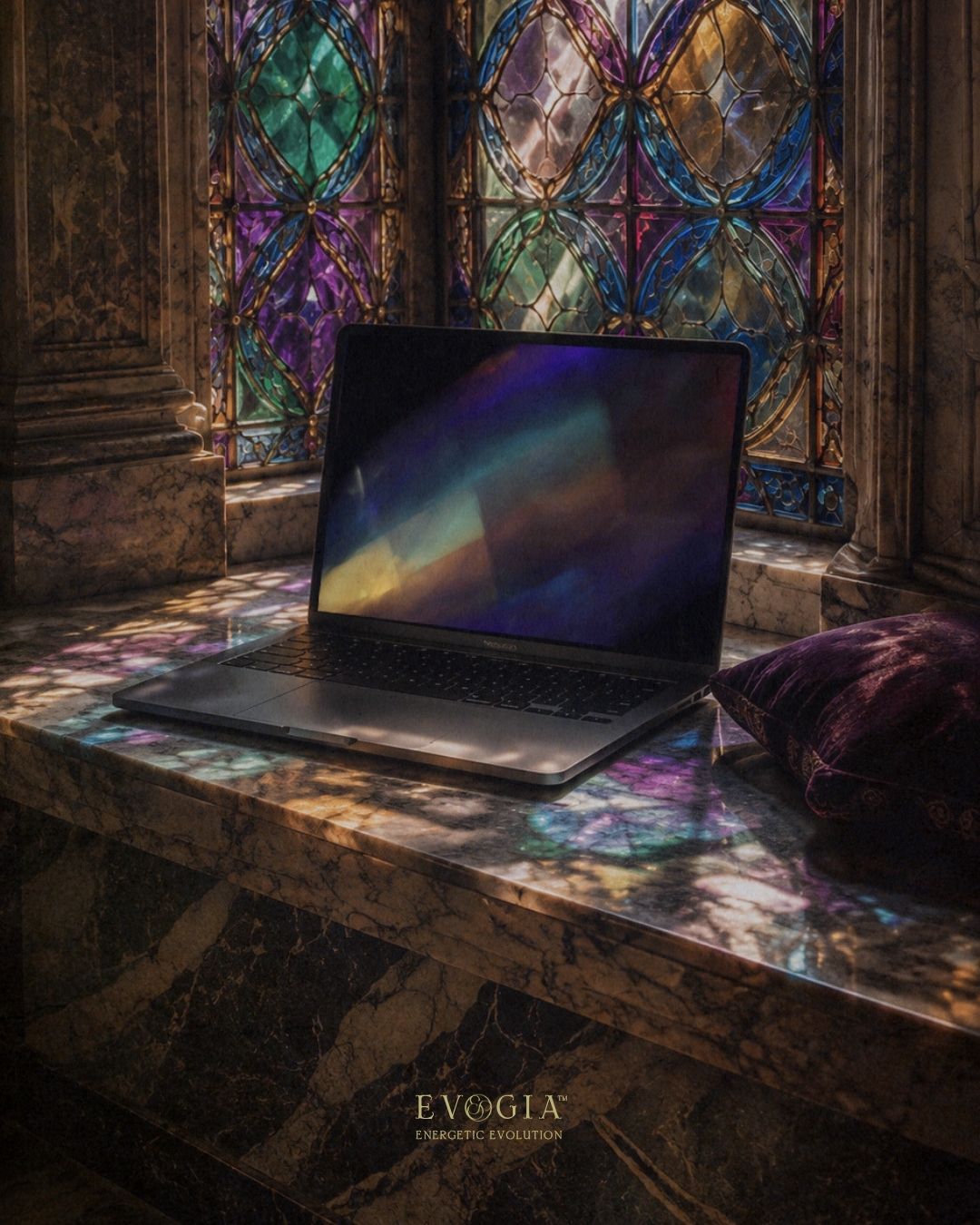
THE REAL SOLUTION – FIELD MODULATION THROUGH INFORMATION
The problem lies in the quality of the field emitted by the device.
So if the field is the cause, the solution must also take place at the field level.
That means the solution is informational.
Information is the primary architecture of reality. If you transform the informational source code from an incoherent, fragmented state into a harmonious field, you change the effect the device has on you.
This is field modulation through information.
This is the idea behind Digital Coherence Technology™.
The aim is to bring harmony to the relationship between human beings and technology.

THE DIGITAL OPERATING SYSTEM FOR HARMONY AT THE FIELD LEVEL
Most wallpapers change only the surface.
A Harmonic Digital Field™ also transforms the level beneath it.
Beneath its visible aesthetic lies a multilayered information architecture:
the Quantum Coherence Protocols™.
They consist of precisely developed field commands, harmonising geometric structures, and a range of carefully coordinated subtle-energy complex preparations.
Comparable to an operating system that runs invisibly in the background.
While you use your smartphone as usual, a second layer works beneath the surface—quietly, unobtrusively, harmonising.
The Harmonic Digital Fields™ create a digital field whose informational quality is designed to be coherent.
This includes, among other things:
• Harmonising manipulative information patterns
• Neutralising disruptive symbolic and field structures
• Stabilising mental clarity and attention
• Harmonising synthetic and collective information fields
• Supporting creative expression
• Neutralising manipulative, parasitic external energies
• Harmonising technological elemental beings
• Neutralising Black Mirror portals
• Informational harmonisation of electrosmog and related influences
• Integrating primordial plant signatures in their original, trauma-free order
• The Evogia™ Gold Standard as the organising foundational architecture of every composition
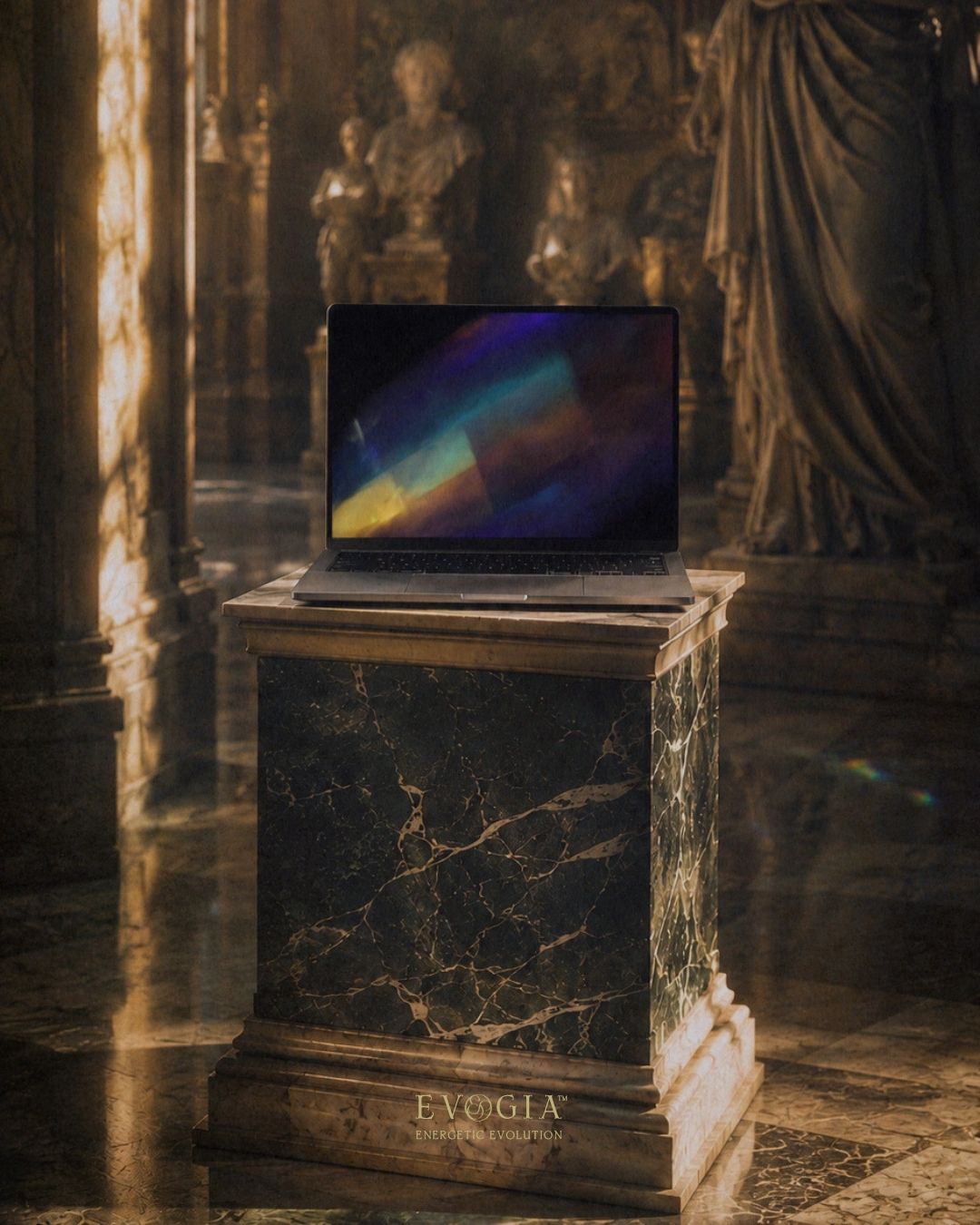
A NEW CHAPTER IN DIGITAL LIFE
Prismera Harmonic Digital Fields™ is a lasting coherence system.
Imagine if your digital devices could become instruments of holistic harmony.
The solution is right in front of you.
READY TO CREATE YOUR OWN EVOLETUM™?

The Evogia™ Story
Evogia™ is the result of a personal journey and a simple realization: the quality of our environment shapes the quality of our lives.

Gold as Standard
Evogia™ is the result of a personal journey and a simple realization: the quality of our environment shapes the quality of our lives.
DISCLAIMER
The effects described for all Evogia™ products are based on quantum-design concepts that fall outside conventional medical and scientific teachings. No medical claims are made, and no promises of healing or health benefits are given.
Evogia™ products are wellness products intended to support a harmonious, consciously designed living environment. They serve aesthetic and atmospheric purposes in spatial design.
These products are not medical devices as defined by the EU Medical Device Regulation and do not replace medical diagnoses, treatments, or therapeutic measures. They are not intended to diagnose, treat, alleviate, or prevent disease.
All content is provided as design and conceptual inspiration to enhance well-being, mindfulness, and personal lifestyle.
Evogia™ - Energetic Evolution